
New Members Guide
An Introduction to Ealing Friends of the Earth
If you’ve recently joined Ealing Friends of the Earth (EFoE), then this section is for you. If you have been active in other groups, then much will be familiar, but we’ll include the basics for those who haven’t any previous experience of environmental or campaigning groups.
We’ll aim to cover:
- What is Friends of the Earth?
- When and where we meet.
- What are our aims?
- Campaigning activities.
- How we communicate among ourselves.
- How we liaise with FoE-UK.
- How this website works – what is where.
- What you can do as a member – from small occasional actions to greater participation.
- What about younger members?
- Is there any training?
- Can I use my existing skills?
- Conclusion.
What is Friends of the Earth?
Friends of the Earth (FoE), founded in 1969, is the world’s largest grass-roots environmental network, with over 2 million members and supporters. We campaign on urgent environmental and social issues, challenge economic and corporate globalisation, and promote solutions that create sustainable and just societies.
Friends of the Earth exists at international, European, national and local levels:
- Friends of the Earth International;
- Friends of the Earth Europe;
- Friends of the Earth UK;
- Ealing Friends of the Earth (EFoE).
Ealing Friends of the Earth (EFoE) is the local group of Friends of the Earth UK for the London borough of Ealing. At the local level we are all volunteers, but we have the support of paid staff in the FoE-UK office in London. We’ve also been around for a long time – some decades now.
Our relationship with FoE-UK
As a ‘local action group’ in the Friends of the Earth network, we are expected to work in partnership with the national Friends of the Earth organisation to promote our shared vision, whilst enjoying some autonomy in campaigning activities.
The full agreement with FoE-UK is in the ‘Local Action Group Charter‘ that we signed. As a rough summary: we behave sensibly as a local FoE group, and in return we get support from FoE-UK such as campaign materials, national campaigns we can participate in, insurance and training. Some of the key points are:
We are expected to:
- Campaign in-line with FoE-UK aims and policies, though with good deal of autonomy. We can choose to work on Friends of the Earth national campaigns, cooperate with other groups on a shared campaigns, or work on self-organised local campaigns.
- Provide FoE-UK with an update twice a year at least, and keep records of finances available for review by members of the group and FoE-UK if necessary.
- Be politically impartial, and not endorse any political party or candidate.
- Adhere to FoE-UK’s policy on protest and non-violent direct action, and not engage in any unlawful activity.
- Adhere to the FoE trademark licence agreement.
Friends of the Earth UK will:
- Provide information, support, training, and networking opportunities to help local action groups organise, campaign, and participate in national activities.
- Enable local action groups to participate in the Friends of the Earth strategy and national campaigns planning.
- Provide public liability insurance to cover normal local action group activities.
- Provide free resources to local action groups to support their local campaigning actions.
When and where we meet
We meet on the second Saturday of the month, except in August and December, when we have a social event instead – typically an outing or picnic in August and a dinner in December. The Next Meeting link on our website shows the date of the meeting and the agenda.
Activities such as stalls or rallies are opportunities to meet other members. Occasionally we organise other social events such as outings, Green Drinks evenings (currently in Acton on 4th Thursday of the month) and daytime coffee-shop meet-ups. There is also a long-standing Green Drinks in Brentford that meets on the first Tuesday of the month and that a number of EFoE members attend.
What are our aims?
Friends of the Earth wants action on the environment both for human survival (climate change, pollution) and to conserve the beauty of our planet (the natural world). Personal change can only achieve a limited amount. We need government and corporate action. Decades of campaigning made little difference to plastic carrier bag use, but a 10p charge mandated by government caused a huge and immediate drop. Government feed-in tariffs have kick-started wind and solar energy technologies.
So FoE aims to:
- Influence Government. Participate in national campaigns, lobby MPs, etc., and engage with local government.
- Build Public Support. Politicians and corporations are more likely to act if there is public support. So part of FoE’s role is educational. We hope to convince people to:
- Act Politically: contact elected representatives (councillors, MPs); sign petitions; take into account environmental policies when they vote.
- Behave differently: reduce impact via a more eco lifestyles; benefit directly (by saving expense, healthier lifestyles, avoiding air pollution hotspots); influence family, friends and community.
- Support FoE locally & nationally: potentially form new local groups, e.g. in colleges.

Campaigning activities
We have a wide variety of activities. Some are in support of FoE national campaigns, while others are our own local initiatives. You can get an idea by looking at the Latest News and Take Action blogs on this website, or at our FB, twitter and Instagram. We:
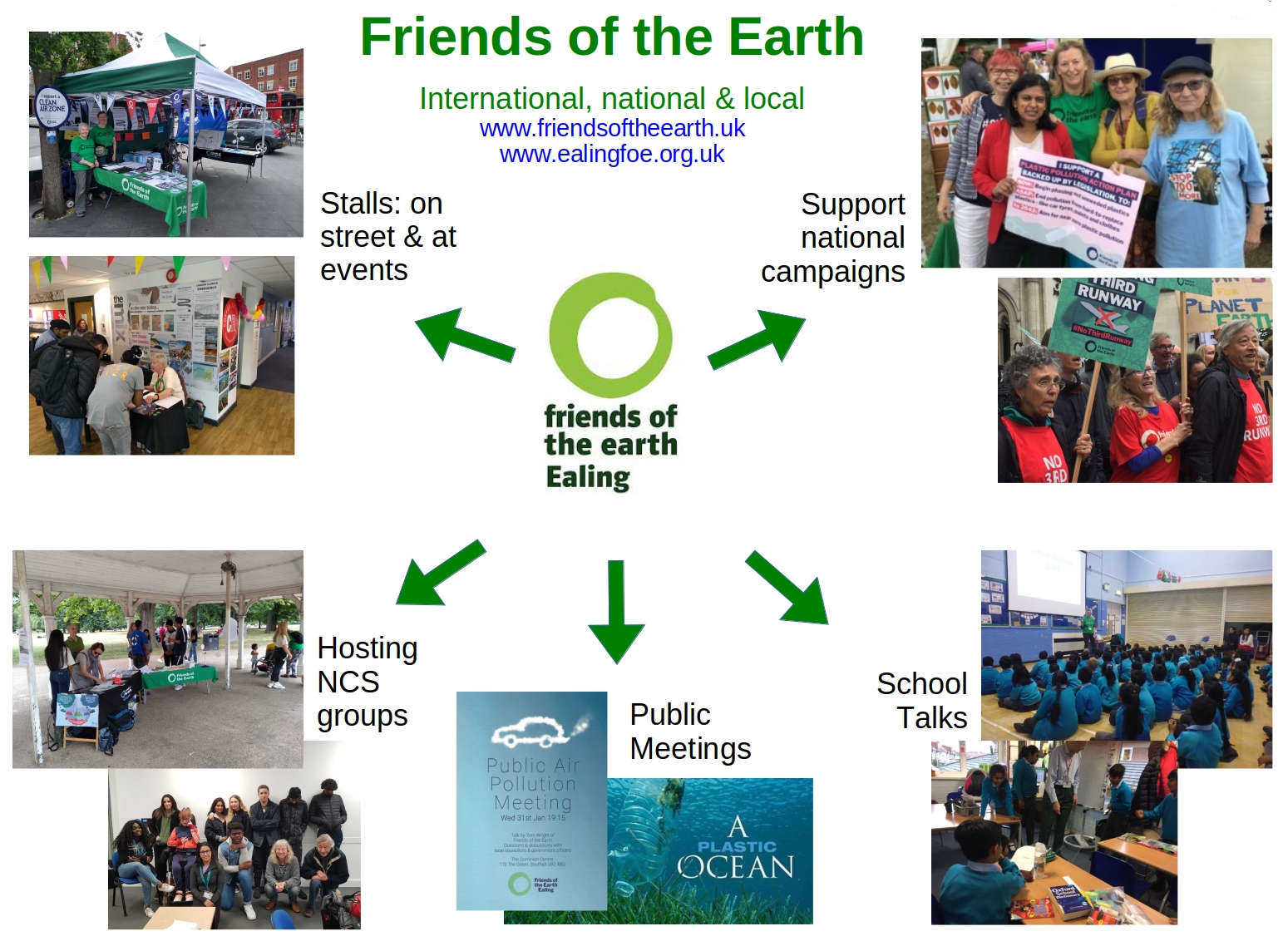
- Hold stalls at public events, school and college fairs, etc. These are opportunities to display posters, talk to the public, distribute leaflets and sign up new members. Regulars are: the Brentford Festival (usually held in an Ealing park), the Hanwell Carnival, the Ealing Animal Fair, Acton Market, West London College freshers fair. Sometimes we are invited to hold one-off stalls at environmental events organised by others.
- Leafleting: For COP26 we handed out leaflets at stations, etc.
- Engage with Politicians: Organise hustings; ask for and compare each party’s environmental policies/manifestos; meet councillors, council staff and local MPs; petitions & letters.
- Respond to Consultations: The Council (and sometimes the GLA and national government) run public consultations. Responding to these requires looking at the environmental effects of Council proposals and writing a response.
- Give Talks: Give talks in schools, etc.. Many primary schools are interested in a speaker for assemblies; typically the head and several teachers will also be present.
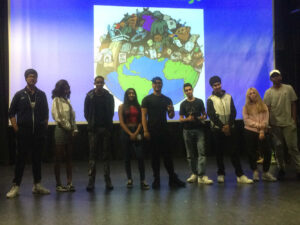
- Host National Citizenship Service (NCS) Groups: This involves hosting a group of young people on the NCS government programme for secondary school pupils, and organising them to carry out some sort of activity related to FoE’s aims.
- Participate in Marches/Rallies: FoE nationally supports various marches etc. such as asking for action on climate, to which we sometimes go as a group. As a charity, FoE does not participate in direct action.
- Organise Public Meetings or Films: E.g. We held meetings on air pollution, and plastics.
How we communicate among ourselves
Primarily by email. Occasional mails are sent to all members (mainly the monthly meeting invite), plus we have a GoogleGroup for those interested in updates, discussion and planning between meetings. We also have a WhatsApp group for general chat. Of course there is the website and you can follow us on FB, twitter and Instagram. Contact details for our officers and other roles are on the Who’s Who page of the website.
How we liaise with FoE-UK
FoE-UK liaise with our group mainly via our co-ordinator. They send regular emails detailing training webinars available, national campaigns we can participate in, London actions (rallies, protests) that we can join. There are occasional meetings of the London FoE groups. There are too many emails to circulate all of them to all members, so what is circulated is usually to the EFoE-Discussion GoogleGroup.
If you are keen to receive more information from FoE-UK, let our co-ordinator know. You can also join FoE nationally – as a supporter you will receive emails directly from them and their Earth Matters magazine by post; importantly, joining also funds their work (the EFoE sub only funds what we do in Ealing). Even without joining, you can still sign up for emails on the FoE-UK website, download publications (including Earth Matters), and view lots of other information.
How this website works
The most frequently updated parts of the website are Latest News, Take Action and Actions and Events, which operate as blogs. At the moment, the home page is fairly static, so visit the blogs to see what’s new and what we are up to.
The Campaigns page is an overview of the issues we campaign on; they are such enormous subjects, we cannot update these very frequently.
Under Resources you will find this new members introduction, some training material and a page where you can download EFoE leaflets and posters.
What you can do as an EFoE member
EFoE is a voluntary organisation. When we discuss possible activities, we do them if we have people willing and interested, and not if we don’t. We don’t want you to feel that if you volunteer once to do something – help on a stall for example – then that means you’ll be expected to do the next one too.
We’re also very flexible. If you have an idea and it fits more or less with FoE aims, you can just float it and see if you get the helpers you need to do it. Perhaps it only needs a couple of people, or perhaps you can even do it alone – a talk for example.
You’ll get more out of being a member, if you get involved in activities … and as a group we’ll be able to do more. But we also know that many of our members have too many other commitments (work, family, other groups) to take on much – if that’s the case don’t worry and we’re grateful for your financial support. So here are some suggestions for things you can do, graded by time and effort, from Modest to Medium to More.
Modest Time/Effort:
- Publicise EFoE’s work on social media – If you see something you like that we’ve put out on our website, FB, twitter, Instagram or via a press release to local papers, share it anywhere you think would be useful, e.g. on a street WhatsApp group, or just mention it to friends.
- Sign petitions – FoE-UK almost always has some running.
- Letters to elected representatives – similarly it’s easy to email your councillors or MP if you want to ask them to support something FoE are campaigning on.
- Attend a social or a stall – it’s good to meet other members; you are welcome to come by a stall to say hello, without any commitment to help.
- Attend webinars or training sessions – if there is something that interests you and you have the time.
Medium Time/Effort:
- Attend a march / rally – that might be a half or whole day out, depending on whether it is local or in central London. Organised environmental marches in central London are very peaceful – the police close the roads to traffic, often there is music or drumming, frequently whole families come and children find it fun. When EFoE decides to attend, we try to go as a group, taking our banner.
- Help on stall – this might involve setting up or taking down (especially where we have to use our own gazebo and tables) and staffing the stall. The latter is easier than you might think – it’s rare to get asked a difficult question, and if you are, there’s usually others of us around or you can offer to get back to them if they leave an email address.
- Respond to a consultation – some are short and simple; however others can involve ploughing through hundreds of pages of documents, in which case there will be some discussion with other EFoE members/officers to agree our response. But this is something you can do in your own time and often with several weeks to do it.
- Organise a one-off event – We don’t have a social secretary so even if we just want to have a members meet-up in a cafe, someone has to arrange it. Similarly for outings or a one-off talk or film. If you can plan just one small event it will add significantly to what we achieve over a year.
More Time/Effort:
- Organise a film, public meeting, or election hustings – organising a public event is a larger task. A hustings is when we ask candidates in an election to give their views on environmental issues, either in a public meeting or on-line, so that voters can compare them.
- Meet elected representatives – occasionally we arrange to meet one of our MPs or Councillors. The meetings won’t be too long but a fair amount of preparation is required.
- Write website posts or press releases – it takes a surprising amount of time and getting work reviewed and proof-read by other EFoE members/officers. But if you like writing, it’s really valuable, especially if it makes us visible in the local papers.
- Design leaflets / posters – as with ‘Write material’ above, it takes time and getting work reviewed by other members/officers.
- Give a talk – Giving talks is a great way to get across to people. Many schools welcome a speaker at their morning assembly and sometimes contact us to invite us; if you have a connection with a school (e.g. as a parent or teacher) it’s easy to suggest this. Typically you’ll need some powerpoint slides and perhaps a few other props. Of course school talks have to be during the working day, which is easy for retired members but not if you have to take time off work. If you are interested in giving talks, we have some slide-decks; if you feel you want to learn but supported by someone else, let us know.
- Take on or help with one of the EFoE group roles – See Who’s Who – or invent a new one!
Younger members
Currently we have few younger members – We’d love to recruit more and hope the current age profile of the group doesn’t put anyone off. There’s no obvious way we can reverse the age profile overnight.
However the whole purpose of FoE is not to talk among ourselves but to get out and talk to the wider public. People of all-ages approach our stalls. Working with an NCS group involves not just the teenagers on the programme but also the NCS co-ordinators who are typically in their 20s. Be creative in what you’d like to do and we’ll try to help – if for example you are at a university, we could give you some support to start a student group either of FoE or perhaps of a more student-orientated organisation like People and Planet.
Is there any training?
Yes, we have some training pages on this website – do take a look. Some members have expressed interest in a mentor scheme or a book group – please say if either of those interest you and we can see what we can set up. If there is sufficient interest we could set up some in-person training – we have slide decks from the school talks we give, that could be the basis of a session for adults.
FoE-UK run training webinars that our members can attend, directed mostly at how to campaign rather than environmental science. One of these is a ‘Welcome to Friends of the Earth’ webinar for new members. Visit their Training and events page for details and to register.
Can I use my existing skills?
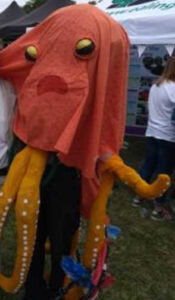
Absolutely, almost whatever they are. Some members have relevant academic qualifications, e.g. in Climate Change. But to communicate to the public we can make use of all sorts of skills – IT, social media, film making and writing, are obvious ones. That’s not all however. When we run stalls we need to attract people to engage – music and drama could help. We’ve used an octopus costume created by one of our members – children visiting the stall had to help free its tentacles from plastic waste it had become entangled in!
Finally …
We hope this has wetted your appetite, whether you have lots of time to offer or only a little. Remember, you can dip in or take a break as you wish. The environment is an issue that’s only going to grow – it’s a climate emergency but it plays out over years and decades, so we are in this for the long haul. If you can’t help now but find you can in a year or two’s time – the cause will still be there and you’ll be welcome.