
Training
Education and Training Material
Our members told us that they would like material on:
- Environmental issues;
- Political engagement (e.g. with Council);
- Activism (campaigning, organising events, etc).
The rest of this page is dedicated to that (some parts are work in progress). Mostly it will point you to suitable resources; we are too small a group to prepare much ourselves and there is no point when so much material is already out there.
We’ll also try to make it as interesting and easy to absorb as possible; feedback is welcome. The first option below is a selection of short videos, some only a minute long!
Environmental Issues
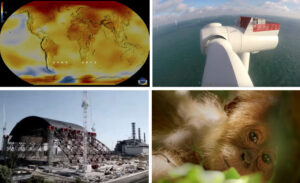
Videos on Environmental Issues
Covering: Climate Change, Renewable Energy, Nuclear, the Natural World.
Learn more about these subjects with videos from respected institutions like NASA, The Royal Society, Desertec and National Geographic, and see real examples from across the world.
These films cover a lot of ground in a short time. The shortest is just 1 minute long.
Books
Work in progress … Here we’ll list some recommended books on environmental themes. While there are some ‘classics’ it is a fast changing area.
Recent books
“Hothouse Earth: A Survivor’s Guide” by Bill McGuire. EFoE has donated 12 copies of this new book (2022) to Ealing Library Service. Why not loan one from your local library! Bill McGuire is a volcanologist and Emeritus Professor of Geophysical & Climate Hazards at University College London. His book is very open and honest about the urgency of climate breakdown. There is a Guardian review of it here.
“The Climate Book” by Greta Thunberg. It’s by multiple experts covering a huge range of topics, with introductions to sections by Greta.
“Zero Carbon Britain: Rising to the Climate Emergency” Published in 2019, this is the latest of a series of reports from the CAT ZeroCarbonBritain project. This report incorporates the latest developments in science and technology to show that we can create a zero carbon Britain using only proven technology. It can be downloaded, or book format is also available.
Classic books
“Limits to Growth – The 30 Year Update” by Donella Meadows, Dennis Meadows, J. Randers, W. Behrens. Four scientists at MIT wrote ‘Limits to Growth’ in 1972, which used computer models to demonstrate the consequences of unchecked growth. This update was published in 2004.
There is also a great podcast about how Limits to Growth came to be written: Tipping Point – 50 years ago, they told us what was coming. Why were they ignored?
“Silent Spring” by Rachel Carson. Published in 1962, and now recognized as one of the most influential books of the twentieth century, Silent Spring exposed the destruction caused by widespread use of pesticides. Despite condemnation in the press and the chemical industry’s heavy-handed attempts to ban the book, Rachel Carson succeeded in creating a new public awareness of the environment, leading to changes in government and catalysing the ecological movement.
“Small Is Beautiful: A Study of Economics As If People Mattered” is a collection of essays published in 1973 by German-born British economist E. F. Schumacher. This book was one of the inspirations for setting up of the Centre for Alternative Technology in Wales (CAT), and the charity Intermediate Technology Group (ITDG) now renamed Practical Action.
“Nuclear Power” by nuclear physicist Walt Patterson. This is the classic and possibly the only book about nuclear written for the general public by someone who knows his stuff. He explains the technology, surveys the history, and describes the danger of coolant-loss meltdowns – as later ocurred in Fukushima and are feared in Ukraine whenever a station loses its grid connection. Published in 1976 (2nd Ed 1982) by Pelican, it is out of print but can be downloaded from his website.
Training Courses
There are in-person and online training courses available. Imperial College ran an evening class ‘Our Changing Planet: Understanding Climate Change and Sustainability’ at their South Kensington campus in the spring of 2023. Check their Adult Education Classes page to see if it is available again.
If there is sufficient interest, we could also organise something locally.
Political Engagement
Here we list some of the ways you can engage with politicians both individually and as part of EFoE.
Tackling the climate emergency and many other aspects of environmental protection, require global and urgent action. Only governments can bring about the wide-scale and fundamental change required. Examples from the past show us that it’s possible.
- During WW2 governments transformed their economies: in the UK factories producing furniture quickly switched to making aircraft; in just a few years, radical new technologies were developed including electronic computers, the jet engine, and atomic weapons.
- More recently, governments took unprecedented steps during the COVID pandemic and vaccines were developed in record time.
- Early government backing for wind and solar led to rapid development, with both now becoming the cheapest forms of electricity generation as well as the cleanest.
Contacting elected representatives
We can contact our representatives as individual citizens, or together as EFoE. In all cases aim to build a good relationship, being polite and respectful, and of course also persuasive, with strong arguments backed up by evidence. And in terms of evidence we are in a good position, because the science overwhelmingly demonstrates the need for environmental action.
To locate and contact your elected representatives as an individual, you can use websites like Write to Them and They Work for You.
There are 3 levels of government we can influence.
- Local: Ealing Council.
- Regional: The London Mayor and GLA.
- National: The UK government and parliament.
Ealing Council
Ealing Council like many across the UK, has declared a Climate Emergency. It has committed itself to making the borough net-zero in terms of carbon emissions. This target is unrealistic becaus councils are very constrained in what they’re allowed to do and in their budgets; even if they were not, the target would require a stupendous effort. But the council does have control or influence over many things of interest to environmentalists, including green spaces, active travel and planning.
We need to be realistic about what can be achieved, however there various avenues to influencing policy – the important thing is to engage and build relationships. As a guide, we’ve reproduced below an interview with a former department head of a large UK local authority, “How can we influence our local council?”. What she says will mostly apply to Ealing or any UK council.
Ealing Council’s website lists our councillors and cabinet members.
More Information
FoE-UK are keen that we engage with our council. They provide information like:
- How to talk to your council on climate;
- Planning and environmental law;
- The English Planning System: An overview.
FoE-UK also sometimes runs webinars for FoE members on working with councils, for example “Climate Action Plan campaign: Overcoming barriers to council action – find out how you can overcome common barriers to getting your council to adopt an ambitious Climate Action Plan.” See the FoE-UK website for what is upcoming.
In terms of Climate Emergency policies, this post Council Climate Emergency Toolkit provides a lot of information about what councils are doing up and down the UK.
How can we influence our local council?
An interview with a local authority department head.
The first layer of government that affects UK citizens is their local council. How can residents and community groups influence its policies? To find out, I spoke to Jyoti Patel who has worked for over 27 years for a major local authority, for much of the time as a department head.
Jyoti explained that councils are limited by the framework set by district (in London, the GLA) and national government. They are bound by law to fulfil statutory functions such as collecting council tax and providing schooling. They also receive direct instructions from above – during the pandemic the government ordered them to close schools. “On some days it seems like there are nothing but constraints!” Councils have complex and varied relationships with the public: “one person might interact with highways by reporting a pothole, while another gets fined for a parking offence”.
Policy development starts with input from the law and government policy. Council officers consult other local authorities, though councillors themselves may be reluctant to do so if the neighbouring authority is run by a different party. Specialist consultants are also used.
A department director owns a policy document, though a junior department member may produce the initial draft. Directors regularly meet the relevant cabinet member. Many in the council – for example financial and legal departments – are consulted.
The cabinet member needs to keep the rest of the cabinet informed, and meetings of the party in power can also influence policy.
A sub-committee of the council containing members of opposition parties as well as the ruling party, has oversight of a policy. “So it’s worth residents talking to opposition parties as well as the majority party.
Residents’ influence “starts with the ballot box and electing the councillors you want”. Beyond that “Councils have an obligation to consult on almost anything” – strategic and local policies – so check for forthcoming consultations. Talk to the relevant cabinet member as early as possible. During public consultations councils have to take your views into account – the ombudsman can intervene if they don’t. For local or specific issues, there are ward forums and planning committees.
Councils also routinely carry out customer surveys about their performance and priorities.
“Be the people who turn up and do stuff!”
‘Soft interactions’ are another route. “Get to know your local councillors, and speak to the MP” – councils are obliged to respond to an MP’s questions. “Be the people who turn up and do stuff”. Councils do try to engage and the response is often frustratingly low.
Has she any examples of residents or community groups successfully changing policy?
Jyoti said “It’s best to get in early when policies are being developed”. However sometimes decisions are reversed at a later stage. She recalled:
- A school closure being reversed by a strong campaign with packed meetings.
- Cuts to social care provision being reversed after campaigners in wheelchairs or on crutches blocked entrances to the town hall, creating terrible publicity.
So Jyoti’s message is ‘residents can influence councils, but need to understand the constraints they operate under’.
[names have been changed]
The London Mayor and GLA
The Greater London Authority has a cabinet post for environment & energy, and is in charge of many things that affect the environment: transport (major roads as well as public transport), planning, housing.
Website: Mayor, the London Assembly and the Greater London Authority.
The UK government and parliament
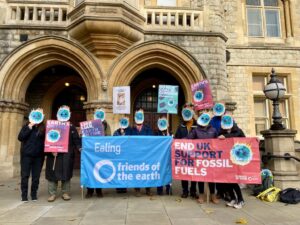
Our main role here is to back FoE-UK’s national campaigns. So we might request a meeting with one of our Ealing MPs to ask them to support one of those campaigns. FoE-UK keep us informed about their campaigns and offer support, materials and training to help us participate.
Parliament’s website explains how to contact your MP or a member of the House of Lords. You can only write to your own MP, however you can also write to ministers and departments.
Activism
This section is about campaigning.
FoE-UK run training webinars that our members can attend. One of these is a ‘Welcome to Friends of the Earth’ webinar for new members. Visit their Training and events page for details and to register.
FoE-UK also provide a number of guides to campaigning. with topics like Campaigning on-line, In-person campaigning, Start or build a group.
Other environmental groups offer similar material.