
Ealing Friends of the Earth's comments on Ealing Council's draft Local Plan
Ealing Friends of the Earth welcomes the Council Leader’s commitment to ‘tackling the climate crisis’ as the first of the “three core themes” of the Local Plan, but we believe that the plan does not put Ealing on track to meet its aim of becoming “carbon neutral, as a borough and an organisation by 2030”.
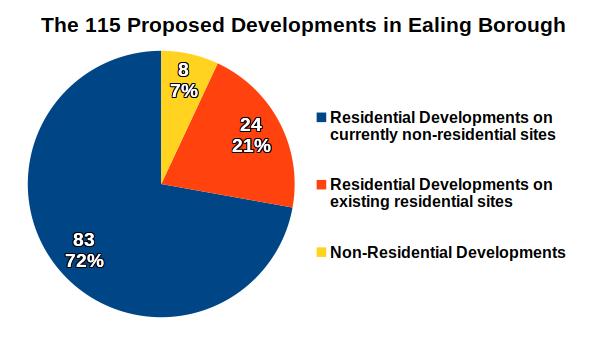
The bulk of the plan comprises a list of potential building sites for residential infill, the construction of which will substantially increase carbon emissions both during build and in-use, especially where tall buildings are permitted given their proven higher emissions per m2. The loss of space for local amenities, Green Belt and MOL, negatively impacts other goals in the plan, and together with allowing out-of-character high rise blocks, irrevocably changes the character of the borough.
Download our full response:
(This is a response to the previous draft of Local Plan. A new version, called ‘Regulation 19’ is now being consulted upon. As Ealing council has not made any significant changes to the draft plan, this response will be largely re-submitted. For more information contact nicferriday@ntlworld.com).
The Context
We note in our response that the main sources CO2 emissions in the borough are:- BUILDINGS, Gas and electricity use, residential and commercial. (over 60%).
- TRANSPORT, mostly road transport. (about 30%).
Buildings
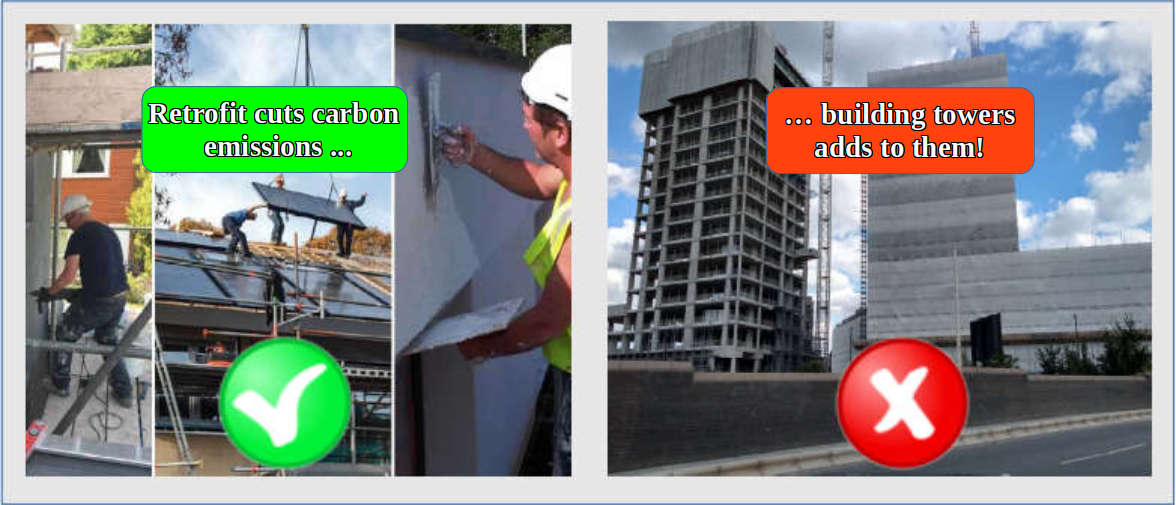
Our response argues that this focus on new-build is wrong and that instead, the bulk of the plan should be dedicated to a massive retrofitting programme of existing buildings across the borough.
Where new build does take place, it should meet the highest environmental standards, as spelt out by the Committee on Climate Change (CCC).
Offsetting and Towers
Our response examines how developers of current new-build sites are able to make small payments to ‘offset’ the lifetime carbon emissions of the buildings (from heating, and electricity use).
Many of the new-build developments are tower blocks. We quote research that shows that tall buildings have higher carbon emissions per unit of floor area provided, both embedded and in-use.
Transport
We support the 20 minute neighbourhood concept described in the Local Plan, with the goal of “enabling people to fulfil the majority of their daily needs within a 20-minute round-trip walk from their homes”.
However in our response we observe that the proposals to redevelop so many non-residential sites to ‘residential’ or ‘mixed residential and other use’, implies a loss of space for other facilities that people need, and contradicts the 20 minute neighbourhood ambition.
Green Belt and Open Spaces
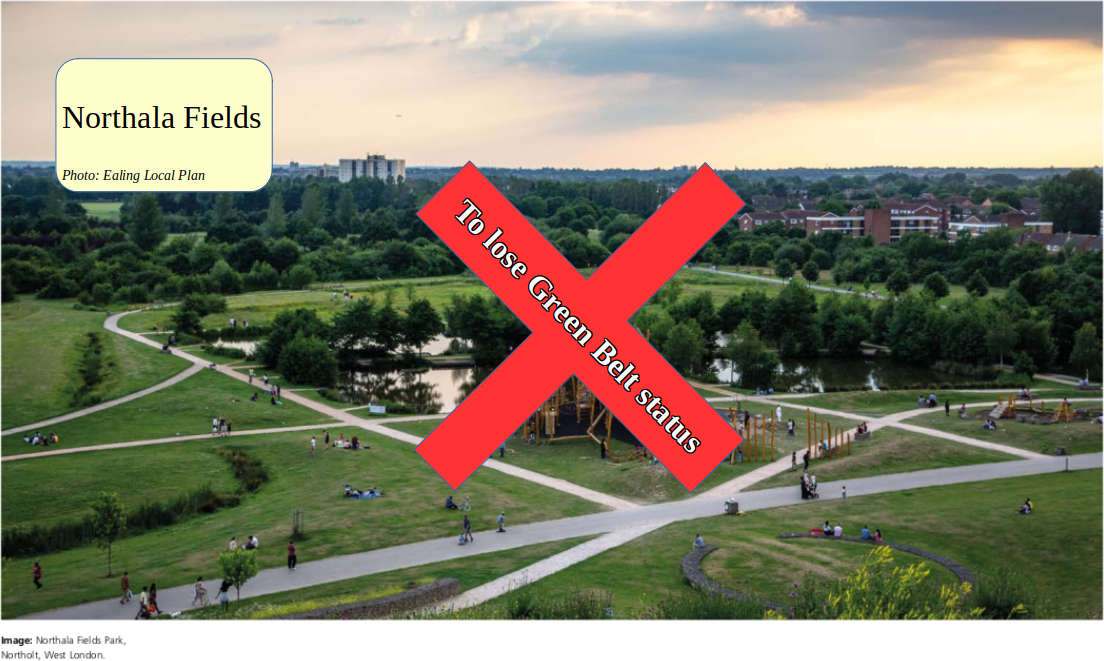
The Local Plan proposes to de-designate ALL of Ealing’s Green Belt and some of Ealing’s Metropolitan Open Land (MOL).
Our response urges the retention of green belt and MOL. The criteria used to de-designate, seem to us to be flawed and to contradict what the ‘National Planning Policy Framework’ says is the essential characteristic of Green Belt: permanence.
Jobs, Growth and Housing
The draft Local Plan sets jobs and growth as objectives. The main growth target detailed in the plan is a housing target of an additional 21,570 units over 10 years, equating perhaps to about 50,000 extra people in the borough.
In our response we query whether the Local Plan should aim to increase Ealing’s population at this rate and by this amount. Once growth ceases as it eventually must, we will be left with more people to find work for and fewer non-residential sites where businesses to employ them could be located.
Growth in housing units and population acts directly against the climate goals in the Local Plan, contradicting almost all of the Plan’s climate and nature goals: emissions reduction, green space, local food, biodiversity, 20-minute neighbourhoods.
Democratic Involvement
We welcome the opportunity to comment on the Local Plan, but observe that getting public engagement with such detailed, lengthy documents and complex issues, is likely to be challenging.
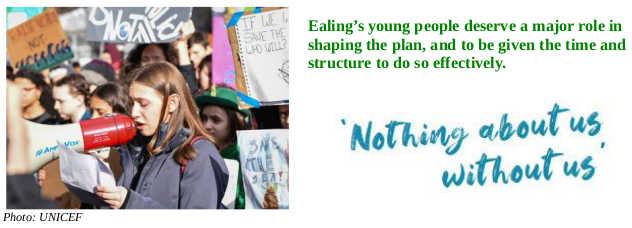
In our response we suggest finding new ways to involve people (such as some sort of local citizens’ assembly), and especially young people, since it is their future.
We suggest that inclusion in the Plan of proposals to develop a site or remove its open space status, should not be taken as public acquiescence, and that the views of residents are better reflected by the many objections to planning applications for such schemes.
Limitations and Openness
An unrealistic plan raises expectations that cannot be met, leading to cynicism about government and democracy.
Making Ealing Borough carbon neutral by 2050, let alone the Council’s 2030 target, is a huge undertaking. Councils cannot be expected to achieve such targets without very substantial support from central government in terms of legislation (mandating stricter building regulations, etc.), finance, and action nationally.
We would prefer the Council to be open about what it can realistically achieve as things stand, and to say loudly and clearly what the obstacles are and what backing it needs from central government or elsewhere to meet the climate goals set out in the plan.
Friends of the Earth UK provides a guide that explains what Local Plans are, why they matter and how you can get involved in their preparation: Local Plans: A Campaigner’s Guide.
To see the Local Plan documents and participate in the consultation, visit the New Local Plan page on Ealing Council’s website. You can also respond by email at localplan@ealing.gov.uk
If you agree with our comments, do respond to the consultation, even if just by an email to say so, or to highlight some of the points you particularly care about.
The consultation closes on 8th February 2023.
I entirely agree with the above response to the consultation. The overwhelming invasion of “high rises” in recent years changes the “feel” and character of Acton as a community and, like almost everybody I know locally, makes us feel we are being swamped by the intruduction of masses of new people, cooped up in small so called “luxury” appartments while local amenities and community services are not sufficiently increased. Many of the existing and original housing stock is poorly insulated and not energy efficient. A lot more should be done about that. Also local community and open spaces should be more protected and developpers should not be allowed to to encroach on those such as the W3 Friary green or the W3 St Dunstable triangles. Another issue is the changing of the historic sky line (e.g. when walking down Churchfield Road) the recent appearance of large tower blocks towering over old Acton buildings creates a claustrophobic feeling of historic Acton being swallowed up by developpers and developments with more traffic and further parking restrictions and less community amenities. Very depressing, it destroys communities and makes one question whether to sell up and go.
I do agree with everything written about over development of Acton. I live close to Gypsy Corner and don’t approve of Barratts proposal for 300 flats on such small land. Please forward this to Ealing Council
I am absolutely horrified at the council’s compleat disinclination to protect our green belt, parks and open spaces.
Instead they wish to take away any protection they have previously had.
Why?
Presumably to allow more greedy developers to get their hands on our dearly loved open spaces.
The reason why Ealing is held in sure high esteem is the nature we enjoy in our Borough.
I am horrified by the loss of green spaces and proliferation of tower blocks that that the Ealing Council Plan proposes. It will destroy the character of Ealing as a pleasant suburb to live in. I do not want to live in a poor imitation of Manhattan.
One of the joys of living in Ealing has been the many views from its open spaces that end at tree height and sky. The intrusion of characterless tower blocks will end that. Also, when fully inhabited, these blocks will only bring more traffic and congestion into surrounding areas and will inevitably increase air pollution.
Ealing Council is already not very good at maintaining its services to residents, such as, for example, its pavement maintenance in many areas It is difficult to believe it will cope any better with the greatly increased density of population that its plan will bring.
The response is a sensible one and recognises that the Council’s intention to increase the Borough’s residential population by 50,000 over the next 10 years will present problems. How those problems will be met and resolved will be down to the Council. Existing residents will have to make up their minds whether they believe our Councillors have the necessary skills to implement such changes and safeguard our homes and quality of life.
I am absolutely horrified at the council’s compleat disinclination to protect our green belt, parks and open spaces.
Instead they wish to take away any protection they have previously had.
Why? What is in the heads of the Councillors making these utterly hideous proposals.
We love our green spaces, they have been completely protected until now. WE ABSOLUTELY DISAGREE WITH ANY PROPOSALS TO IN ANY WAY DENUDE OUR PRECIOUS GREEN SPACES in order to allow more greedy developers to get their hands on our dearly loved open spaces.
The reason why Ealing is held in such high esteem is the nature we enjoy in our Borough.
I am appalled at the proposal of the removal of MOL on areas of Ealing. It contravenes the 2022-2027 biodiversity action plan outlined by Ealing Council. The reasons to protect Ealing, the Queen of suburbs, and all it’s open land areas are multiple and imperative.
I do not see eye to eye with the Green Party on everything but on this it has my complete support. It appears that Ealing Council under Ealing Labour have complete and utter contempt for the environment, green space and democracy itself. Time and time again, they have over ridden public opinion to allow inappropriate development after inappropriate development and their addiction for building skyscrapers on every historic low rise residential street corner knows no bounds and no scruple. Ancient woodland will not stand in their way. Nor will historic manor houses. Pubic opinion? The mere buzzing of a mosquito in the ear of someone like Peter Mason. Democracy? A mere inconvenience to a fanatic socialist. Ealing is absolutely full to the brim with people. We don’t need any more. The UK needs housing, yes, but it’s not a matter for local councils. It’s a matter for government and the mayoralty who are the only organisations that can form a holistic joined up strategy that considers the suitability of all sites across all of London and build only on the most suitable.
[REPLY from Ealing Friends of the Earth: Thank you for your comment, but please note that we are not the Green Party. Friends of the Earth is a national charity and is not affiliated with any political party. We press for good environmental policies from local and national government, whatever party happens to be in power.]